National Removals and Storage
How Many Boxes Do I Need for a House Move?
Most homes need between 20 and 70 boxes, depending on their size and how much is in the cupboards. This guide gives rough numbers by home size, then explains how to count more accurately and which box sizes to use.
- Written scope
- Inventory and access
- Liability and terms
- Named contact and complaints

Written and reviewed by James Sanders, founder of National Removals and Storage
Last reviewed

The short version
The short answer
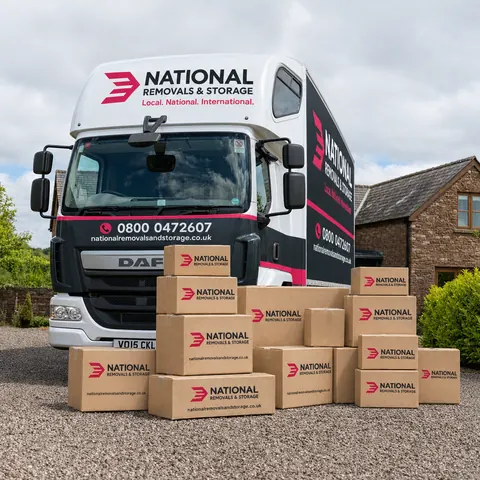
As a rough guide, a one-bedroom flat needs about 20 to 30 boxes, a two-bedroom home 30 to 50, a three-bedroom house 50 to 70 and a four-bedroom house 70 or more. Books, collections and full kitchens push the number up. For a better estimate, count the cupboards, shelves and drawers you are emptying rather than the rooms, and check the loft, garage and shed before ordering. Use small boxes for heavy things and large ones only for light, bulky items, and add your boxes to the volume calculator so the vehicle size is right.
 Real team, real vans
Before you book
What to know
The main points, in the order you are likely to need them.
By home size
About 20 to 30 boxes for a one-bedroom flat, 30 to 50 for two bedrooms, 50 to 70 for three and 70 or more for four.
Count cupboards, not rooms
Count each cupboard, shelf and drawer you are emptying, and look in the loft, garage and shed before you order.
Small boxes for heavy things
Books and tins go in small boxes; large boxes are for light, bulky things such as bedding and cushions.
Want us to run these checks with you?
Answer three quick questions and our team will come back with a written quotation.
Hold us to it
Use the same checks when comparing us
A useful checklist should work for every company you consider. Ask us for the same written detail: the agreed inventory, access assumptions, included work, liability terms, payment schedule and the person responsible for your move.
Written scope
Check that the quotation states what is moving, which services are included and what could change the price.
Inventory and access
Make sure stairs, lifts, parking, long carries and unusual items are recorded before move day.
Liability and terms
Read the liability limits, exclusions, cancellation terms and claims process rather than relying on a verbal summary.
Named contact and complaints
Confirm who will coordinate the booking, how changes are recorded and where a complaint can be escalated.
Good questions
Frequently Asked Questions
Answers to common questions about how many boxes do i need? and how the service works.
How many boxes for a three-bedroom house?
About 50 to 70 as a rough guide, but a house with a full loft, lots of books or a large kitchen can need more.
Is it better to have too many boxes?
A few spare boxes help on moving morning, when the last items always need somewhere to go. Unused flat boxes are easy to store or pass on.
Do boxes affect the price of my move?
They affect the volume of the load, which sets the vehicle and crew size. Add them to the volume calculator or show them at the survey.
A rough guide by home size
These ranges are only a starting point. A home full of books, collections or kitchenware can need far more, and a lightly furnished flat far fewer.
- Studio or one-bedroom flat: about 20 to 30 boxes.
- Two-bedroom home: about 30 to 50 boxes.
- Three-bedroom house: about 50 to 70 boxes.
- Four-bedroom house or larger: 70 boxes or more.
Read next: Packing tips
Count cupboards, not rooms
A better estimate comes from going round the house and counting what you are emptying: each kitchen cupboard, bookshelf, chest of drawers and wardrobe. Most kitchen cupboards fill one or two boxes, and a full bookcase can fill five or more small ones.
Lofts, garages and sheds are where totals go wrong most often. Look inside them before you order boxes, not on packing day.
Which sizes to use
The heavier the contents, the smaller the box should be. A large box full of books is hard to carry safely and more likely to split.
- Small boxes for books, tins, tools, paperwork and anything heavy.
- Medium boxes for kitchenware, toys and most general items.
- Large boxes for light, bulky things such as bedding, cushions and lampshades.
- Wardrobe boxes for hanging clothes, which stay on the rail.
Read next: Removal boxes and packing materials
Boxes and the size of your move
Boxes take up more space on the vehicle than most people expect. Our volume calculator counts a standard box as 3 cubic feet, a large box as 5 and a wardrobe box as 12, so thirty standard boxes take about the same space as a three-seat sofa, an armchair and a coffee table. Add your boxes to the calculator so the vehicle and crew size are right.
Read next: Volume calculator · How much storage space you need
Packing
Part of our packing guides
How to pack, label and protect your belongings, and when to hand it to a packing team.
- Packing tips for moving house
Room-by-room packing, labelling and materials advice that saves time at both ends.
- How to pack fragile items
Glassware, mirrors, pictures and ornaments: wrapping, boxing and loading them safely.
- Removal boxes and packing materials
What is included with a fixed price move, what a typical move uses and how to tape and label boxes.
- How to pack a kitchen
Plates, glasses, pans, food and appliances: packing the room that takes longest.
- What removers will not move
Hazardous items, valuables, food, plants and animals, and what to do with them instead.
Services and tools for this stage
Need boxes for your move?
All our fixed price moves include packing materials. Tell us your home size and we will include the right boxes in your written quotation. Call 0800 007 4564.